

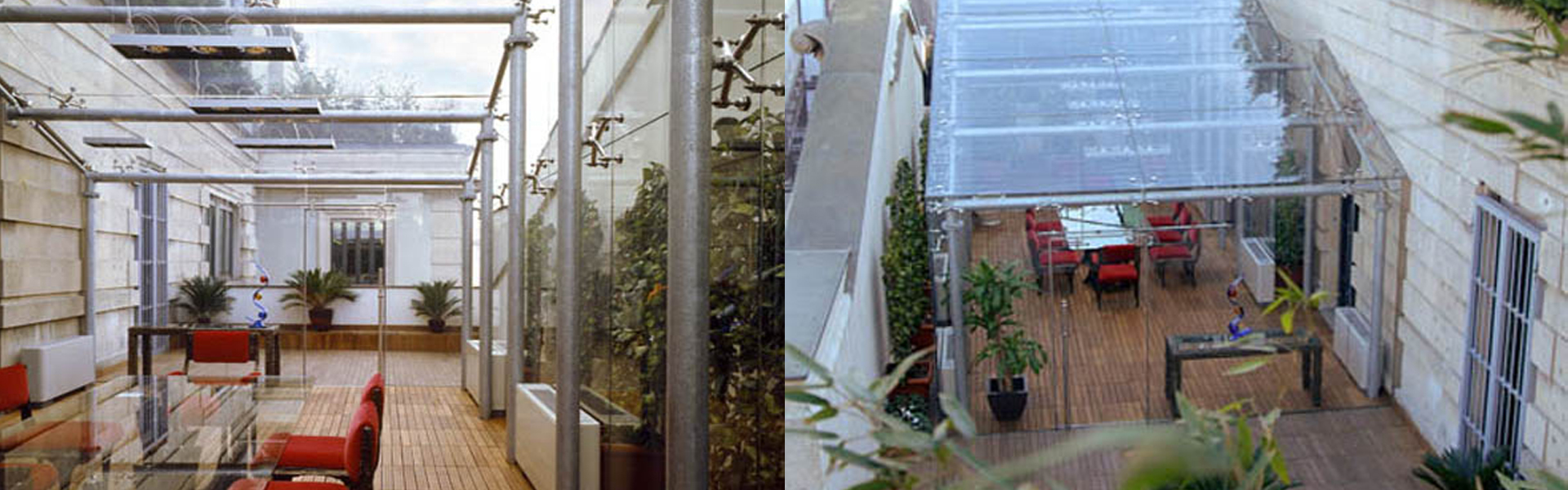
The creation of self-supporting glazings poses several technical challenges for architects and engineers, which can now be easily overcome thanks to sophisticated systems offered by glass processing and installation techniques. In particular, these systems include the Spiderglass fixing system, which allows for the creation of both external cladding for large-scale facades and glass walls for separating interior environments, and U-Glass (or U-profiled glass), which enables the construction of large structures without the need for framing.
The main challenges caused by the creation of curtain walls include water and air tightness, maintaining performance over the long term, acoustic silence, attention to thermal dispersion and the greenhouse effect, and accessibility to external glazed surfaces. The glazed surface has always been an essential component for curtain walls, but the use of self-supporting glazings initially caused issues related to the transparency of the glass itself: lack of privacy, excessive heat, and a lack of thermal and acoustic insulation are drawbacks that have been overcome with the introduction of special glasses capable of providing increasingly sophisticated performance and more secure fixing systems suitable for large structures, maximizing environmental comfort.
The VEA System
For example, the Spiderglass point-fixing system, also known as the VEA system, allows for the creation of larger self-supporting glazed surfaces compared to traditional fixing systems of equal pane thickness. Characterized by the presence of stainless steel ball-joint bolts called “rotules,” the Spiderglass fixing system allows for numerous applications, including the creation of canopies, self-supporting vertical facades, interior partitions, or building roofs. Thanks to optimal stress resistance and elasticity, Spiderglass self-supporting glazings are suitable for even very large glass structures, provided they are designed taking into account the structural limitations of the glass and the load stresses applied to it. However, by adhering to these points, it is possible to design and create self-supporting glass glazings that do not sag or settle under their own weight.
U-Glass also allows for the creation of self-supporting glass facades for external or internal use. Characterized by its typical U-section and a slightly rippled surface capable of uniformly diffusing light and solar rays, U-Glass is a translucent profiled glass available in reinforced or low-emissivity versions. It allows for the creation of self-supporting walls, dividers, internal partitions, and decorative elements, as well as cladding, roofing, and canopies, with vertical installation in single or double walls, ensuring a high-quality finish.