

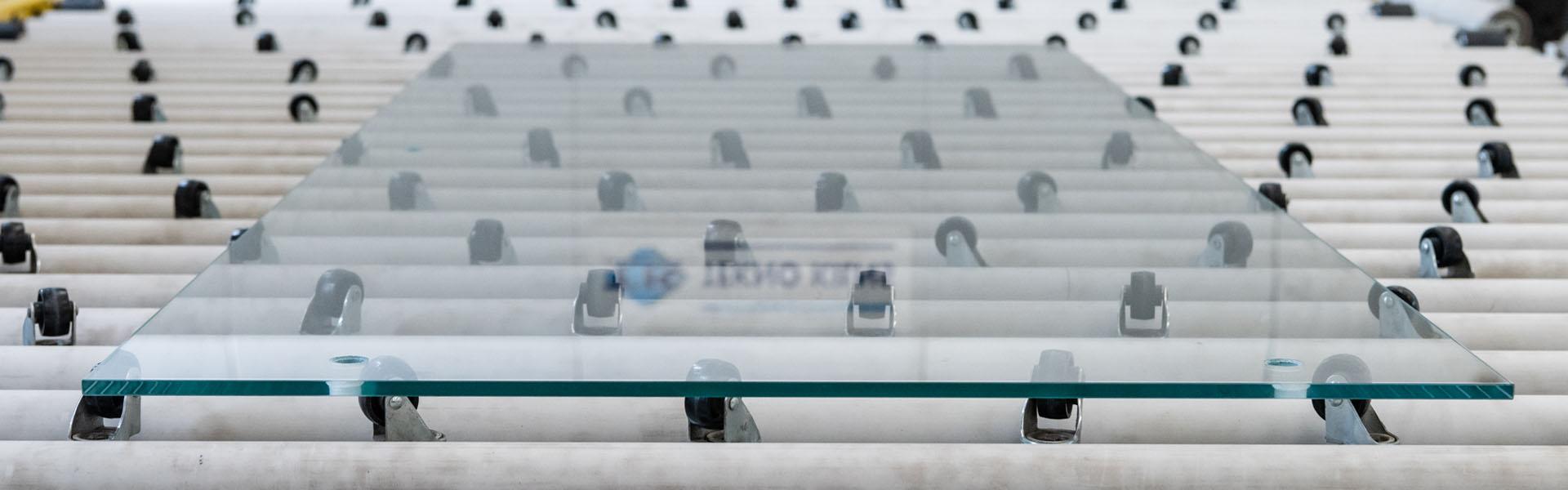
Tempered glass is obtained starting from the heating of a normal float glass pane, which is placed inside a special furnace and heated to the “glass transition” or tempering temperature (approximately 640 °C), causing the softening of the structure. Once softened, the glass pane is extracted from the furnace and abruptly cooled with high-pressure cold air jets, which cause only the outer surface to harden, while the interior remains hot, and therefore viscous, for longer.
The Characteristics of Tempered Glass
The thermal tempering process allows for the production of glass distinguished by strong internal tensions: the distensive tensions characterizing the interior contrast with the compressive forces affecting the outer surface. The presence of these tensions grants tempered glass high mechanical resistance to bending and thermal shock. Furthermore, thanks to this specific treatment, tempered glass is rightfully classified among the so-called safety crystals—those that, in addition to protecting people and goods from vandalism, break-in attempts, robbery, and smashing (anti-vandalism, anti-intrusion, shatterproof, and bulletproof crystals), do not pose a danger to personal safety even in the event of accidental breakage.
In fact, even if they should break, tempered glasses do not shatter into a few sharp and cutting pieces like normal glass. On the contrary, the tension and compression forces present in the glass instantly cause the formation of cracks, which result in the shattering of the glass into many small, non-sharp, and therefore non-dangerous fragments. Tempered glasses are thus capable of ensuring active security and passive safety, so much so that some call it anti-injury glass. Regarding Italian regulations on safety glass, tempered glass is identified in classes 1(C)1; 1(C)2; 2(C)2. Tempered glass is marked with the appropriate UNI or CE branding, with reference to the UNI 12150 standard, ensuring long-lasting comfort.
The Fragmentation Test
The safety of tempered glass can be verified by requesting the execution of the so-called fragmentation test: perimeter-locked and resting on a flat surface without mechanical constraints, the tempered glass is struck with a sharp steel tool capable of causing breakage at a precise point (specifically, this point is located 13 mm from the edge and exactly at the midpoint of the long side). At this stage, within 5 minutes of breakage, fragments are counted and the largest fragment is measured, excluding the area around the impact point with a 100 mm radius and the perimeter edge for a depth of 25 mm.
Despite being considered a safety glass in all respects, tempered glass is not suitable for use as fall protection. In the event of a fall due to breakage from a certain height, while breaking safely, tempered glass can produce cohesive pieces of glass to which the weight acquired during the fall can grant high danger (cluster effect). For this reason, for all safety applications concerning tempered glass and crystal, or coupled and laminated glass, it is always advisable to consult expert professionals capable of recommending the most suitable solution for every situation to achieve a prestigious finish. In these cases, it is necessary to evaluate whether it is appropriate to externally apply a laminated glass product composed of two tempered or heat-strengthened glasses, providing a high level of acoustic silence.