

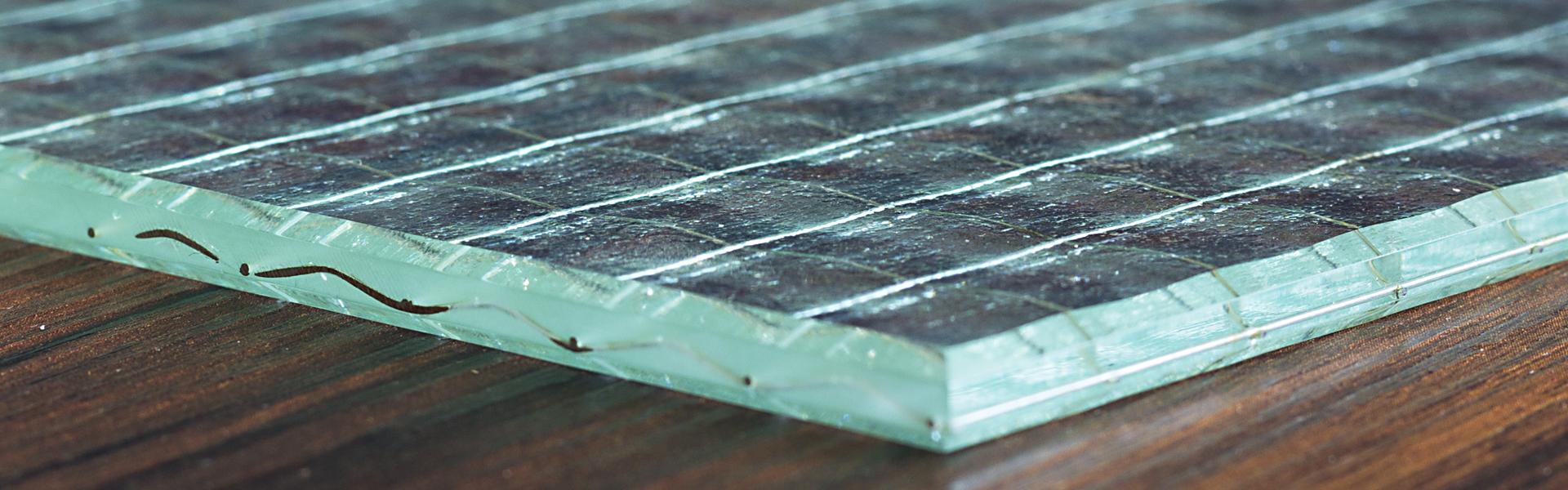
Wired glass is a specific type of polished glass that is not perfectly transparent, yet still allows light to filter through. Characterized by a grid of chrome-plated metal wires—which may run only in the direction of the casting or form a complete mesh—wired glass is a transparent soda-lime glass with smooth, flat, and parallel surfaces that offers important fire-resistant properties. It is produced by casting and laminating two sheets in a molten state, with an electrically welded square-mesh steel grid placed between them, which keeps the sheet cohesive even if it breaks.
Technical and Chemical Characteristics of Wired Glass
From a technical and chemical standpoint, wired glass is obtained through continuous casting and rolling, immersing a mesh of thin, lightly tin-plated steel wires into the molten glass. Thanks to this internal grid, wired glass is granted an RE classification, certifying its fire stability and flame tightness. Indeed, wired glass possesses good mechanical fire resistance and does not emit flammable gases during a fire. In the presence of flames, the mesh distributes heat uniformly across the entire surface, ensuring the sheet stays together and preventing it from exploding, even if the glass melts upon reaching its softening point (600/700°C).
Due to its reticular structure, wired glass melts slowly without generating the stresses that would cause it to shatter explosively. To guarantee full fire protection, however, it is essential that the wired glass is mounted in a specific frame capable of securing its edges. Furthermore, in the event of accidental breakage, the metal reinforcement holds the glass shards in place, also providing a medium level of protection against break-ins and vandalism. Nevertheless, the DIN 18361 standard does not classify polished wired glass as a safety glass because, while it offers good resistance to impact and keeps fragments cohesive, it lacks specific safety-glass fracture characteristics.
Where to Apply Wired Glass
Produced in nominal thicknesses of 6 mm and 10 mm, wired glass can have a maximum length between 1650 mm and 3820 mm and a maximum width of 1980 mm; it cannot be annealed. Regarding aesthetics, wired glass can also be tinted or decorated with specific patterns that reduce the clarity of vision through the pane. Common applications for wired glass include glass parapets, skylights, main doors, and windows in stairwells and buildings, as well as any situation requiring fire resistance. Wired glass is classified among G30 class fire-resistant glasses (for more details on fire-rated glass, see the sections dedicated to fire-resistant and fire-retardant glazing and RE/REI classifications).