

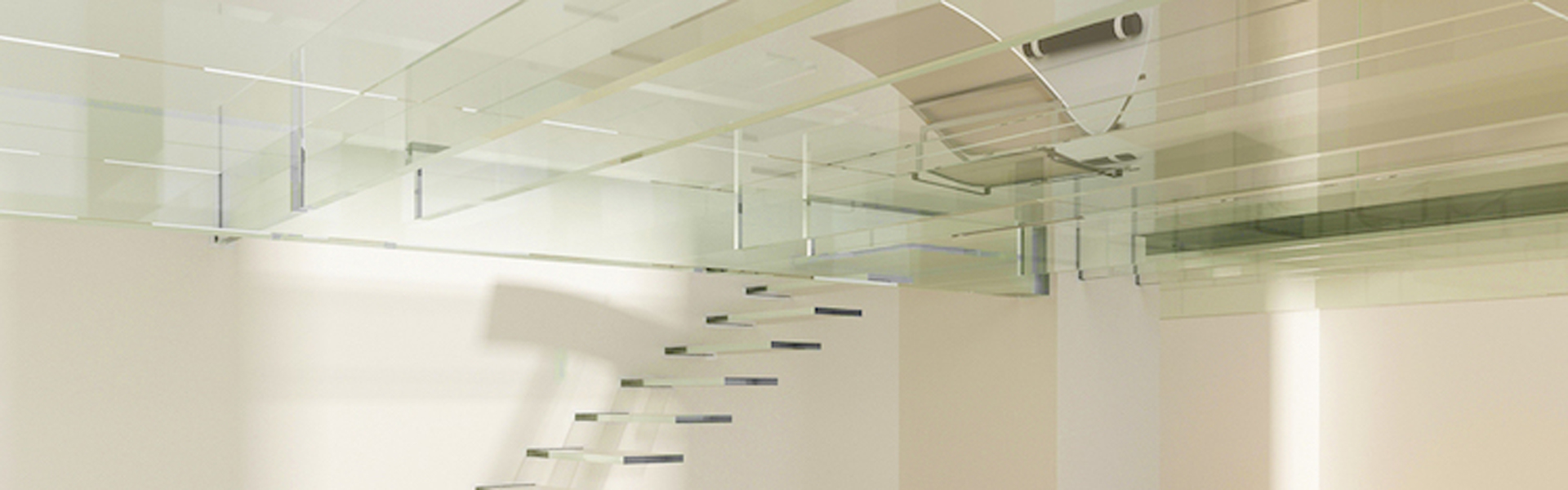
Structural glass is widely used in the creation of architectural works. In compliance with building safety regulations, structural glass can be manufactured in flat or curved shapes depending on the application. Curved glass is achieved by bending common glass along a single axis (horizontal or vertical), whereas bending along both dimensions results in hollow glass, used for items like bottles and vases.
Structural Glass and the Bending Process
Structural glass, whether flat or curved, must be certified by national and international bodies to guarantee its quality and durability. Used for elements like beams, columns, or self-supporting facades, structural glass must ensure human safety even in the event of breakage.
To produce curved structural glass, the sheets undergo a gradual heating process in a bending furnace at temperatures between 500 and 750°C. This makes the glass viscous enough to adhere to a concave or convex mold. Mechanical or pneumatic devices often assist the process. This is followed by a “detensioning” or “annealing” phase to stabilize the glass. For the furniture sector, the process ends with instantaneous cooling to induce the properties of tempered glass, resulting in a high-finish, resistant curved structural unit that enhances environmental comfort.
Tempering and Lamination
The safety characteristics of curved structural glass can be further enhanced through tempering or lamination. Laminated glass is made shatterproof by coupling two or more panes with an adhesive plastic film (PVB), fixed with heat. This provides a structural solution that maintains acoustic silence and safety. Tempering increases mechanical resistance and eliminates the risk of breakage from thermal shock.
Curved laminated glass is primarily used in construction for architectural coverings, partitions, full-height windows, elevators, and facades. Curved tempered glass, on the other hand, is a preferred choice for high-end furniture applications. Both forms offer versatile solutions for modern architecture, prioritizing safety and aesthetic excellence.