

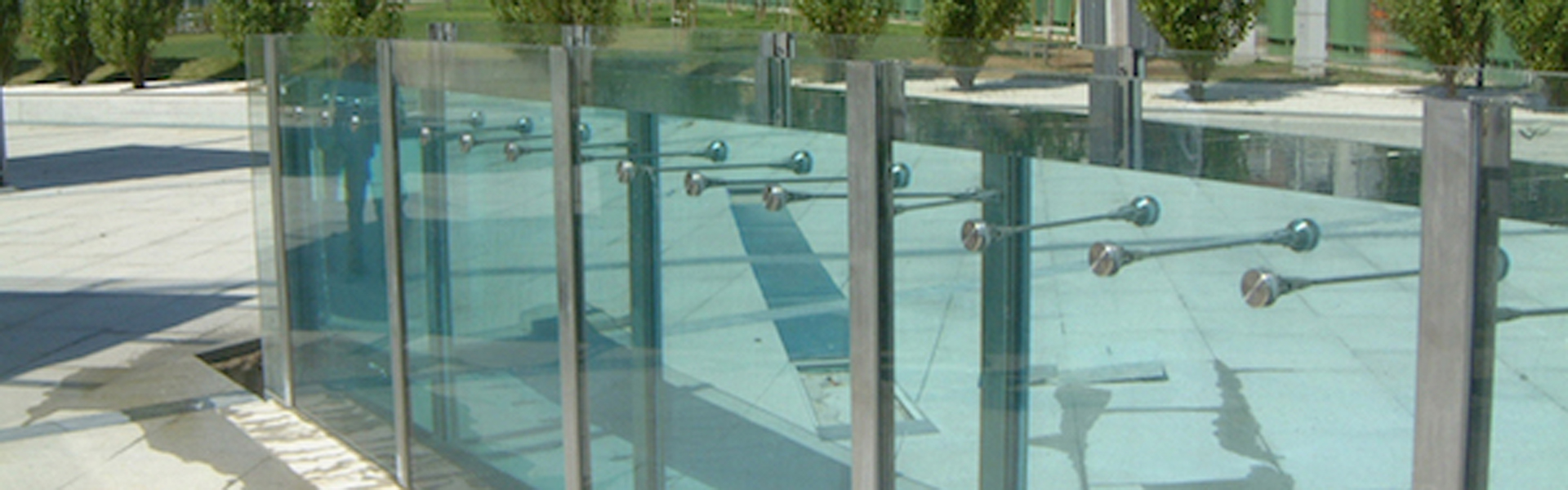
Vetreria Re, active in the production, installation, and sale of artistic glass, structural glass, and safety crystals since 1989, specializes in the production, supply, and assembly of glass for the construction industry. The category of construction glass includes all those types of glass whose thermal and mechanical resistance characteristics are enhanced through specific processing. Construction glass or structural glass is suitable for creating architectural works of various scales in residential, industrial, and commercial construction.
Tempered or Toughened Glass
The construction glass offered by Vetreria Re includes tempered or toughened glass, a particular type obtained through a thermal treatment called tempering. This process grants the glass specific resistance to impact, thermal shock, and bending. To obtain a toughened safety crystal, the sheet must be placed in a special furnace heated to the glass transition temperature (approximately 640 °C) and then suddenly cooled with jets of cold air. This causes the outer surface to contract and harden while the inner part remains viscous longer. Tempering induces a state of permanent tension in the glass sheet, providing superior thermal and mechanical resistance.
Tempered glass is used in all situations requiring high levels of active and passive safety, particularly where the glass must withstand thermal stress, although it is not suitable as fall-protection glass. Thanks to its impact resistance and tendency to break into blunt, non-sharp fragments, this type of glass is a key component of safety glazing. Its robustness makes tempered glass a perfect structural material for creating architectural elements without a supporting framework, such as doors, partitions, shower enclosures, and all-glass railings, as well as for applications in the automotive industry, ensuring a high-quality finish.
Laminated or Layered Glass
Laminated or layered glass is made by joining two or more layers of glass with a plastic adhesive sheet (PVB or polyvinyl butyral), which keeps the sheet intact even in the event of breakage, preventing the dispersion of sharp shards. The level of security can be increased by increasing the thickness and number of glass layers and plastic films. Furthermore, laminated glass offers good thermal insulation and acoustic silence, lending itself to extensive customization.
Regarding applications, laminated glass is particularly suitable for residential, commercial, and industrial construction. It is widely used for shop windows, shatterproof windows and frames, armored doors, and bank counters. Laminated crystals are employed wherever a potential fall or breakage could cause damage to people or property, and where high protection against vandalism or intrusion is required. Depending on the level of protection, it is possible to obtain accident-prevention, anti-intrusion, shatterproof, and even bulletproof glass, maximizing domestic and professional comfort.
Armored Glass
Armored glass is a superior class of safety glass, composed of at least three layers of glass and two sheets of transparent PVB adhesive. Armored glass also features high levels of passive safety; even if broken, fragments remain bonded to the structure, preventing injuries and hindering intrusion.
Suitable for installation in residential or work environments, public buildings, shops, museums, banks, or sports arenas for creating display cases, parapets, windows, and full-height glazing, armored crystals increase both active and passive security. Active security (security) is the glass’s ability to prevent unwanted intrusion, while passive security (safety) means that even in case of breakage, the armored crystals do not cause harm to people or property.
Insulating Glass
Insulating glass is also considered construction glass, offering both economic and ecological advantages due to its ability to reduce the need for heating and cooling systems. Whether consisting of double glazing—two or more glass sheets joined with an air gap—or low-emissivity magnetron-coated glass, insulating glass also offers good shatterproof safety characteristics.
Finally, construction glass includes structural glass used for self-supporting glazing made with the Spiderglass fixing system or with U-Glass (U-profiled glass), which allows for the creation of large structures without complex frameworks. The Spiderglass point-fixing system (VEA system) uses special “rotules” (stainless steel ball-joint bolts) to create larger self-supporting glass surfaces compared to traditional systems.
With the Spiderglass system, it is possible to create both external cladding for very large facades and partitions for interior environments in residential, industrial, or commercial construction. U-Glass, characterized by its typical U-section and slightly rippled surface that uniformly diffuses light and solar rays, is an excellent construction material for self-supporting glass facades for both internal and external use.
Vetreria Re, over 20 Years of Glass Processing
Vetreria Re, active for over 20 years in glass processing and structural construction projects, is today a leader in the sector, available to carry out the most complex custom projects for public or private clients. The use of glass in construction is governed by strict regulations that aim to ensure safety in structural applications while promoting eco-compatible behavior.
Regarding energy efficiency and glass applications in construction, UNI 7697 is the primary regulatory reference in accordance with Italian Legislative Decree no. 206/2005 and Law no. 229/2003, implementing EU directives. This regulation governs glass safety performance and general product safety, establishing that responsibility for correct application involves the designer, builder, window manufacturer, and installer.
Furthermore, for material control and supplier reliability, reference can be made to quality certifications and marks, such as:
-
The mandatory CE mark, indicating conformity with relevant European EN standards;
-
ISO certifications, which attest to formalized rules within the manufacturing company;
-
The voluntary UNI mark, granted only to products whose manufacturers have obtained qualitative certification from qualified external bodies. This guarantees that the producer performs the prescribed controls on materials, processes, and products, maintaining a quality level superior to legal minimums.
The uses of glass in construction are countless and destined to grow thanks to technological advances in processing and chemistry. Strictly regulated by law and guaranteed by safety controls, the application of structural glass achieves optimal levels of thermal insulation and acoustic silence, moving towards sustainable construction while increasing both passive (safety) and active (security) protection.