

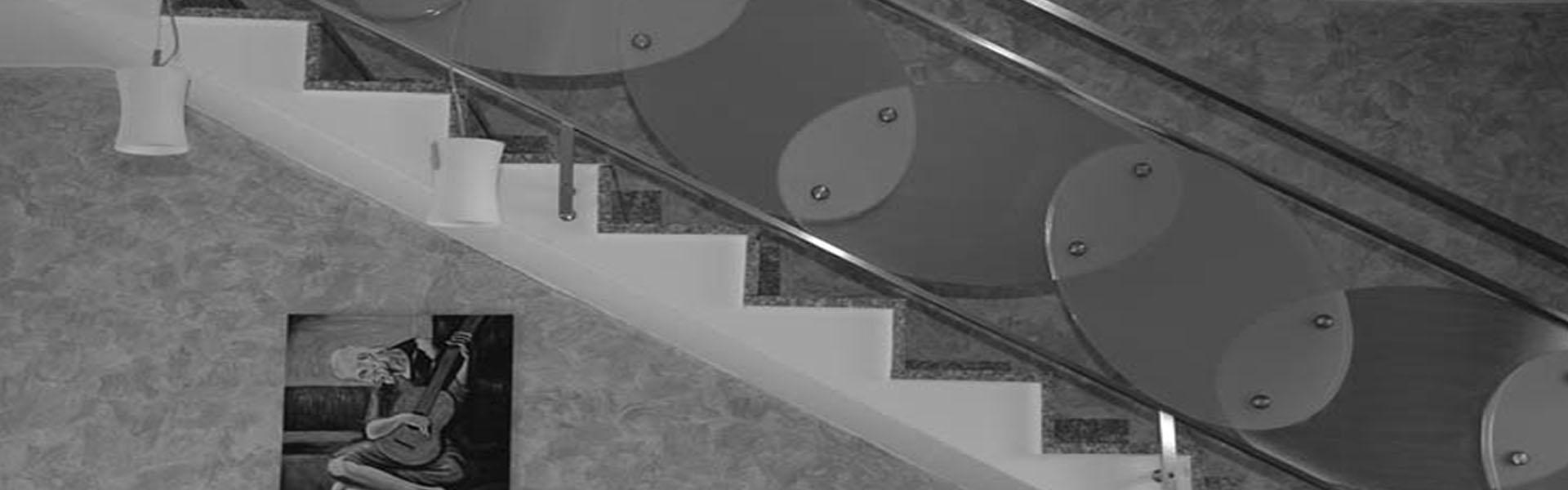
Today, the glass industry offers a vast selection of increasingly sophisticated crystals to meet various practical and aesthetic needs of both public and private clients: from double glazing to magnetron-coated glass for increased thermal insulation, from glass block to artistic glazing, and from armored, laminated (or paired), tempered, shatterproof, or anti-intrusion safety crystals to accident-prevention glass, the application of which is regulated by precise legal standards concerning construction safety and workplace security.
The Characteristics of the Various Types of Glass
Understanding the different characteristics of various types of glass can help the client gain a clearer perspective when consulting a professional installer, who can provide highly detailed and specialized information. However, it is essential to keep in mind that, especially in the private or professional security sector, it is fundamental to turn exclusively to competent professional staff with long and extensive experience in the field. Only professionals with several years of activity in the sector, such as Vetreria Re in Nerviano, are capable of certifying the actual safety of environments, preventing potentially dangerous situations and their undervaluation.
As mentioned, the glass industry offers numerous increasingly sophisticated products applied for the prevention of and/or protection from crimes, attacks, fires, vandalism, and accidents, as well as from thermal dispersion and atmospheric agents. Each of these products is distinguished by specific processing, production, and assembly characteristics that grant the crystal the sought-after properties. In particular, laminated glass can provide protection against accidents, crime, vandalism, and even bullets, depending on the specific characteristics conferred during processing.
Laminated glass is divided into different security classes, certified by UNI 7172, 9186, and 9187 standards—which indicate characteristics, dimensions, tolerance capacities, measurement methods, and testing methodologies applied—and are not used for simple commercial purposes. Let’s look at the different levels of protection provided by laminated crystals, used for the production of doors, gates, windows, armored doors, shop and bank windows, automatic doors, parapets, canopies, and much more:
-
Accident-Prevention Laminated Glass: Even in the event of accidental breakage, the pane does not pose a danger to personal safety, thanks to its ability to break without shattering: the blunt glass fragments remain adhered to the adhesive plastic membrane inserted between the two (or more) glass layers. Accident-prevention glass is therefore used to prevent injury and risks of falling.
-
Anti-Vandal Laminated Glass: Capable of resisting the impact of blunt objects thrown with force.
-
Anti-Crime Laminated Glass: This type of glass can offer various levels of resistance against repeated impacts aimed at criminal purposes.
-
Bulletproof Laminated Glass: This type of laminated crystal can resist the action of bullets fired from firearms.
The European draft standard prEN 50131-1 proposes a true “Security Glossary” that uniquely indicates definitions and characteristics of different types of safety glass, including accident-prevention glass. For the classification of shatterproof glass, reference is made to the UNI 9186 standard, which provides for three resistance classes. Before illustrating the current regulations regarding accident-prevention and safety glass, it seems appropriate to briefly present some of the main definitions concerning laminated and tempered safety and accident-prevention glass.
The Classification of Shatterproof Glass
Laminated Glass
Flat glass panes, layered and made monolithic by the interposition of PVB (polyvinyl butyral) sheets, a plastic binder characterized by variable thicknesses. Thanks to autoclave processing, the structure becomes extremely robust and resistant to smashing attempts or gunfire. Laminated glass also includes panes with polycarbonate sheets interposed, a material capable of significantly increasing shatterproof and bulletproof properties.
Accident-Prevention Glass
Accident-prevention glass is a type of laminated or tempered glass classified as a structural material used for accident safety (Safety), not for anti-crime security (Security). This means it does not have shatterproof or bulletproof characteristics and is therefore not suitable for bank or shop windows, but rather for glass doors, glazings, glass partitions, and other installations where personal protection is important. Upon impact, it breaks without producing sharp shards, and fragments remain adhered to the plastic film, keeping the panel in place. Depending on the number, thickness, and assembly sequence of glass panes and PVB sheets, laminated glass will present different levels of resistance, ensuring a safe Finish and household Comfort.
Anti-Vandalism Glass
A type of laminated glass capable of resisting violent and repeated blows from bricks, stones, iron bars, hammers, and blunt objects. It breaks but remains in place, protecting people and goods. Resistance characteristics vary based on the assembly of the panes and PVB binders.
Shatterproof Glass
A type of laminated glass where the resistance to smashing can be optimized based on the number, thickness, and sequence of the glass panes and PVB binder sheets.
Anti-Crime Glass
A type of laminated glass capable of providing different degrees of resistance to intentional criminal attacks.
Bulletproof Glass
The choice of assembly is aimed at optimizing resistance to projectiles. The UNI EN 1063 standard proposes a complete classification with seven classes for handguns and rifles and two for hunting rifles. Resistance increases with the thickness and number of layers. They can be:
-
Simple Bulletproof: Stops bullets, but may project shards from the side opposite the impact;
-
Bulletproof and Anti-Spall: Stops bullets and prevents dangerous shards.
Anti-Explosion Glass
Classified into four resistance classes against pressure caused by explosion according to UNI EN 13541:2002. They can resist the shock caused by explosions of devices with different TNT content. The maximum resistance corresponds to class ER4.
Tempered Glass
Obtained through a specific heating and immediate cooling process, this glass can only be used in accident-prevention (Safety) applications as it is not classified as anti-crime (Security). It crumbles into blunt, non-sharp fragments upon breakage and provides excellent Acoustic Silence.
The Consolidated Act on Safety
Accident-Prevention Glass Regulations:
Regarding the legal aspects regulating the installation of accident-prevention glass, glass is increasingly common in structural works but can be dangerous if not treated. Threat of breakage from shocks, fires, or explosions must not be underestimated. For workplace security, glass surfaces are regulated by Legislative Decree 81/2008, the “Consolidated Act on Safety.”
-
Article 1.3.6 of D.Lgs. 81/2008 (Annex IV): Transparent or translucent walls, especially all-glass walls, near workstations or traffic routes must be clearly marked and made of safety materials up to 1 meter from the floor, or separated so workers cannot come into contact with them or be injured if they shatter.
-
Article 1.6.11 of D.Lgs. 81/2008 (Annex IV): If transparent surfaces of doors are not made of safety materials and there is a risk of injury, they must be protected against smashing.
Before D.Lgs. 81/2008, the field was regulated by D.Lgs. 626/94. Although no longer in force, “Law 626” remains important for shifting the focus from “reparatory” intervention to prevention and information. For glass safety in construction, reference is made to Law 311, D.M. 11/3/2008 (thermal), D.L. 2/12/97 (acoustic), and UNI 7697/07 (safety).
Italian Standard UNI 7697 of January 2007:
-
UNI 7697/2007 (Point 1): Provides criteria for choosing glass for internal or external use to ensure glass performance meets minimum safety requirements.
-
UNI 7697 (Point 5): Frames and containment grooves must not compromise glass performance.
-
UNI 6534 (Point 3.3): Frames must be solid enough relative to the glass mass and mechanical wear.
UNI EN 12150-1 and UNI EN 12543-1 Definitions:
-
Tempered Glass: Thermally tempered safety glass with permanent compression stress induced by controlled heating (600-650 °C) and sudden cooling. It crumbles into harmless fragments.
-
Laminated Glass: Panel of two or more panes joined by plastic material, usually PVB.
Laminated Glass Classifications (UNI EN 12600):
-
Anti-Injury Class 2(B)2
-
Fall-Prevention Class 1(B)1
-
Anti-Burglary (UNI EN 356): From Level 1 (P1) to Level 8 (P8A).
-
Bulletproof (UNI EN 1063): From Class BR1 to BR7.
Classification considers: static loads (weight, snow), dynamic loads (wind, crowd), vibrations, hail, seismic stress, impact from a person (UNI EN 12600), vandalism (UNI EN 356), projectiles (UNI EN 1063), fire (UNI EN 357), and explosions (UNI EN 13541).
Risks classified as:
-
Damage to people or property;
-
Falling into the void (heights $\ge$ 1 m);
-
Social damage (artworks, explosives, etc.).
Safety rules by application:
-
Residential: All glass below 1 m from the floor must be tempered (if no fall risk) or laminated. Above 1 m, tempered or laminated is still recommended.
-
Tertiary Sector: Internal and external glass must be tempered or laminated regardless of height.
-
Parapets: Laminated glass is mandatory. If no frames on four sides, tempered-laminated glass is required.
-
Public Buildings: All glass must be laminated or tempered.
-
Roofing: Glass facing the interior must be laminated; tempered-laminated is preferred to resist thermal shock and mechanical stress.
Vetreria Re is available for further information, quotes, and technical surveys.