

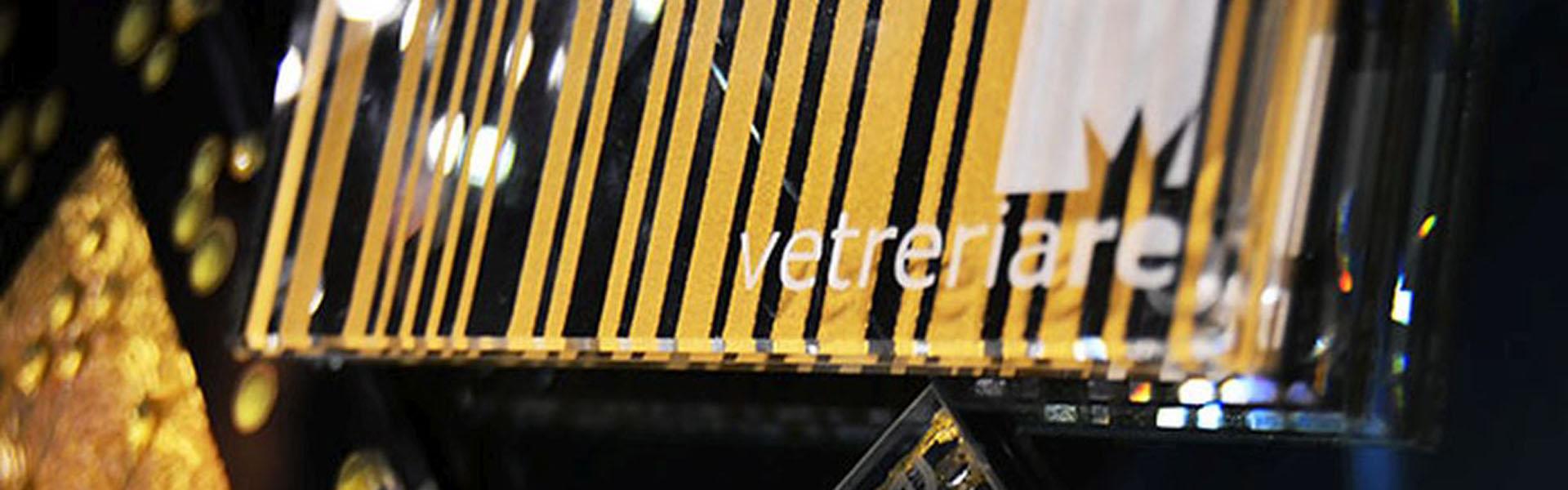
Born in 1989 as a small family-run business, Vetreria Re has expanded over the years in terms of turnover and production capacity, but it has never forgotten the artisanal origins from which it began more than twenty years ago. Specializing in the creation of custom solutions born from a unique project developed with the client, Vetreria Re caters both to architectural firms focused on design and technology, and to private individuals seeking the quality and personalization possibilities that only glass can offer. The creation of artistic glazings constitutes a significant portion of Vetreria Re’s activities, dedicating extensive resources and creative energy to producing unique decorations through functional and creative glass-working techniques, such as sandblasting, enameling or painting, lead binding, and lamination with fabric or wire mesh. Among these techniques, gold leaf stands out for creating unique and unrepeatable artistic glazings.
Gold Leaf Decorations: The Technique
Gold leaf, as the name suggests, is a decorative technique consisting of applying a sheet of gold—usually 22 karats and extremely thin—onto glass or other surfaces. Gilding can be applied to metal, wood, and glass surfaces through various methods. The use of gold or silver leaf for artistic glazings or decorative glass objects utilizes techniques inherited from the ancient Greeks and Romans, later revived by Venetian artisans in the 15th century. To perform artistic decoration on glass, the gold leaf is laid onto a surface previously coated with a flux; then, using a specific bone or plastic tip, the decorator removes the excess parts of the design, which is then indelibly fixed to the glass through annealing, ensuring a high-quality finish.
But let’s look at the most widespread techniques for decorating glass with gold (or silver) leaf.
Mission gilding is a technique for applying gold leaf to any previously painted or non-porous surface, making it suitable for glass decoration. The technique takes its name from the adhesive liquid used, called “mission” (or mixture), and essentially consists of applying the gold leaf to a surface previously coated with water-based or varnish-based mission. Water-based mission allows for a faster application, as it sticks in a few minutes, and is suitable for moderately porous surfaces. Varnish-based mission is a longer process, requiring at least 3 hours to dry, but the final result ensures greater brilliance and is ideal for compact surfaces like metal, marble, and glass, enhancing residential comfort.
The water gilding (guazzo) technique, which is difficult to execute, is used for applying gold leaf to glass and other materials like wood. Applying gold leaf via water gilding involves several stages, all equally important for the success of the final decoration. First, the glass surface must be thoroughly cleaned, first with water and then with alcohol; then, by dissolving transparent fish glue in a double boiler in distilled water, the tempera is prepared, which must be very fluid and lump-free. Once filtered and cooled, the tempera is poured along the upper edge of the vertically positioned but slightly inclined glass. Using a squirrel hair brush and being careful never to touch the leaf with fingers, the gold leaf is brought close and applied in one single motion. To ensure it is perfectly flat, wrinkles must be removed by running more solution along the upper edge. Once dry, a piece of velvet is rubbed over the surface to give the glass its luster, providing a sense of acoustic silence and elegance. Finally, a protective varnish is applied to the entire surface.
Water Gilding
The water gilding technique is also used for wood and other materials using an insulating filler made of rabbit glue and Bologna plaster; once dry, the surface is sanded, and heated bole is applied. After the bole dries, the gold leaf is applied using a “gilder’s knife” to slide it onto a leather cushion. To facilitate the grip, it is advisable to cut the gold sheet into smaller pieces. Finally, heated fish glue is spread on the bole, and the gold leaf is applied using the squirrel hair brush until the piece is completely gilded.
Gold edge gilding is the most traditional technique for applying gold leaf, common in bookbinding as well as for decorating metal, wood, and glass. The technique is complex and involves overlapping a layer of clay or egg white onto glues or plasters previously applied to the surface. The gold leaf is then applied and, after resting for a couple of days, is polished and protected with transparent varnishes.
Hot stamping is a more modern method for gold leaf application, used mainly in graphics for reproduction of friezes or lettering on prestigious book covers. The gold leaf is applied via a plastic support, onto which a heated bronze punch is pressed: pressure and heat release the mixture of gold and resin.
The decoration of artistic glazings through the application of gold or silver leaf is an ancient technique repeatedly reworked and modified by artisan workshops over the ages. Today, gold leaf decoration allows for the creation of artistic glazings of unique refinement that can provide personality and taste to any environment. Vetreria Re designs and creates doors, windows, partitions, flat crystals for tables, furniture displays, lamps, ornaments, and various other architectural elements embellished with gold leaf decoration.