

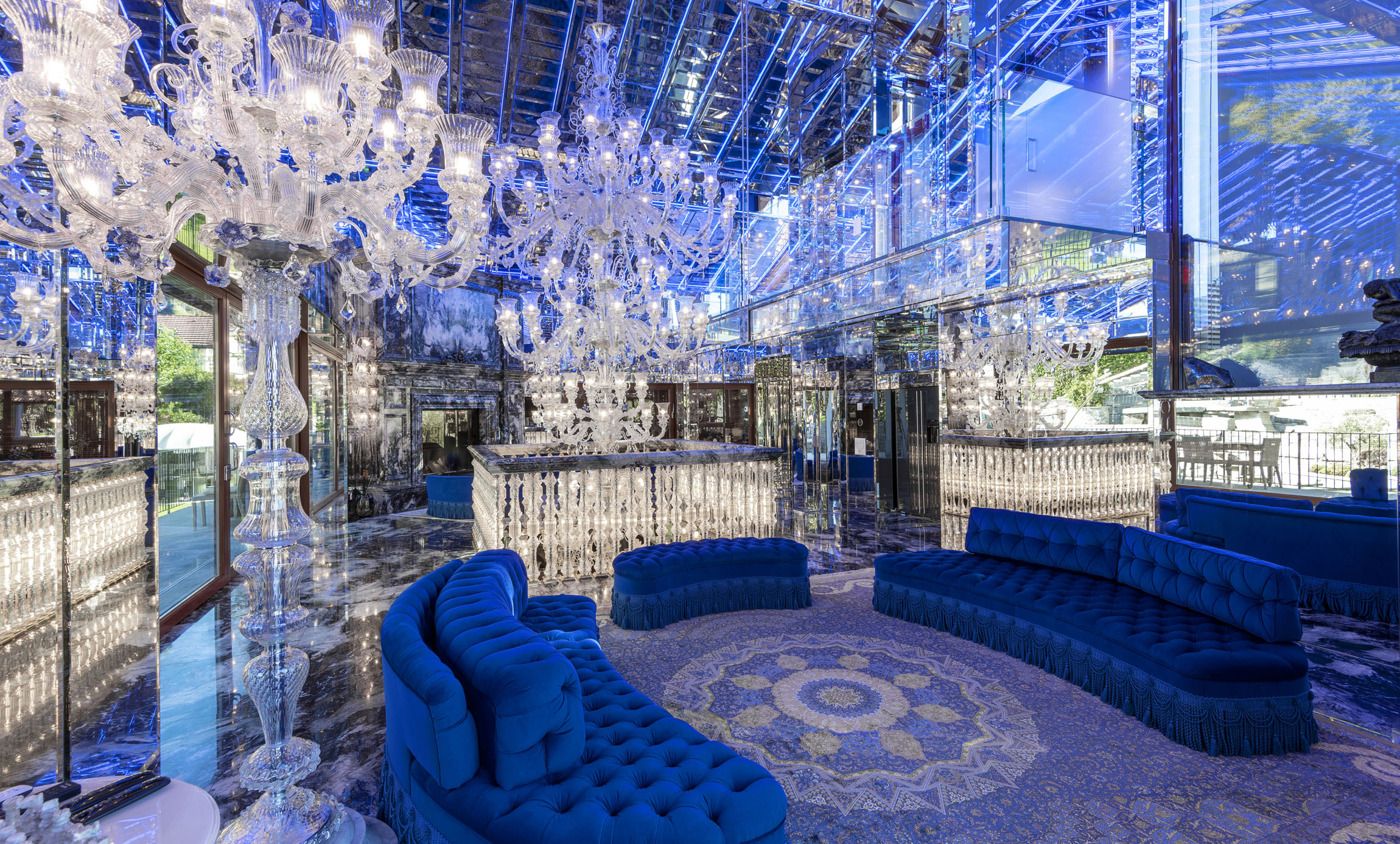
Vetreria Re’s solutions always look toward innovation and design. In this context, the evolution of reflective surfaces has marked a fundamental transition: the mirror has overcome its purely functional dimension as a wall accessory to become a true element capable of redefining space identities.
Designing a mirror wall means directly intervening in volume perception, transforming a vertical boundary into a dynamic opening element. When integrated into a room’s architecture, decorative mirrors do not merely reflect an image; they shape light, enrich depth, and redefine the spatial boundaries of prestigious residences and environments.
Geometries of Light and Space: The Visual Impact of Reflective Walls
The use of reflective surfaces meets precise compositional needs. In narrow corridors, entrance areas, or rooms characterized by reduced lighting, inserting a mirror cladding makes it possible to go beyond wall limits. Space expands, multiplying perspective and pleasantly transforming proportion perception.
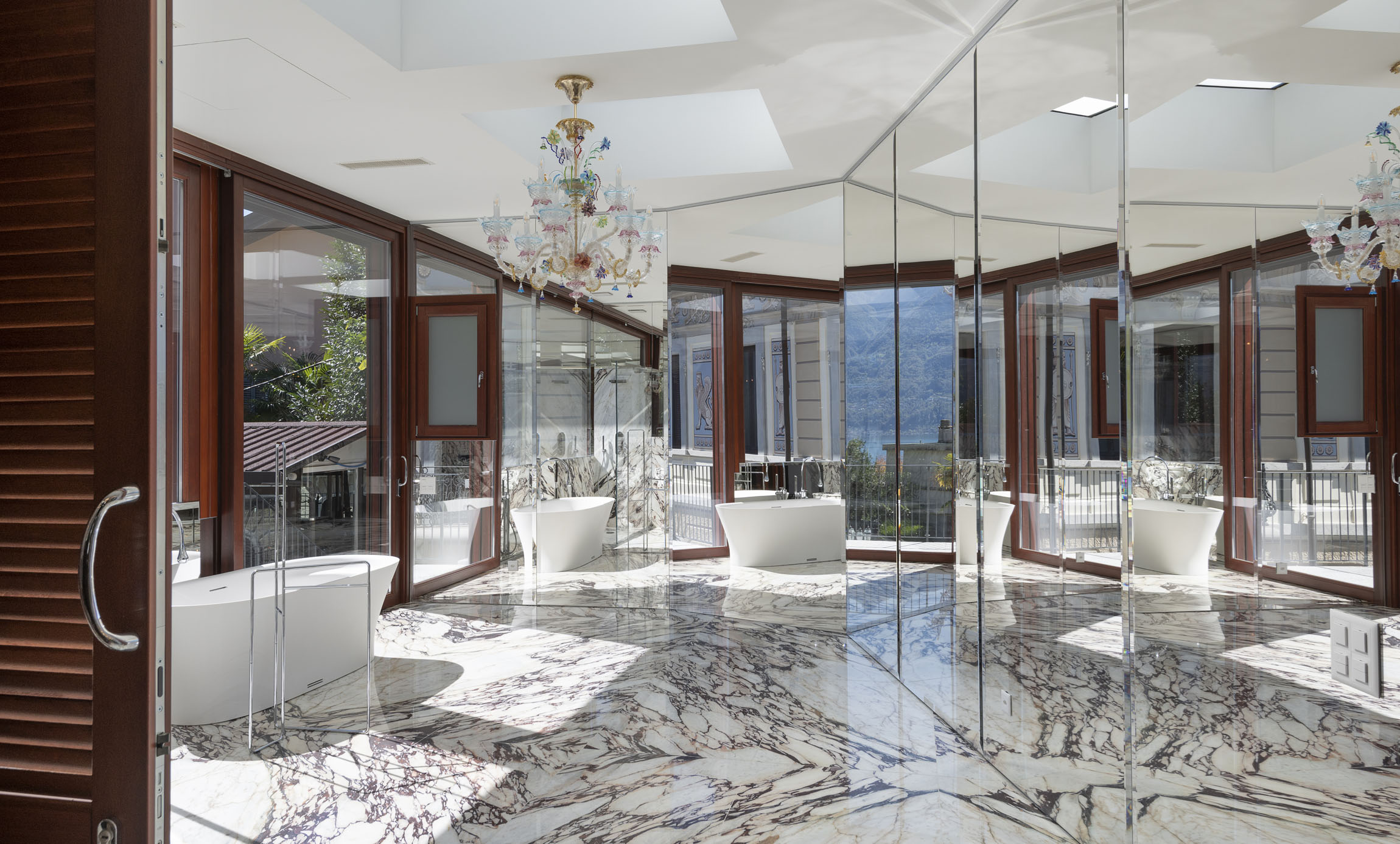
Equally important is lighting management. Positioned opposite a natural light source or a window, mirror walls capture light beams and diffuse them throughout the room, amplifying daylight performance. This process requires careful calibration, as the ultimate goal consists of evenly distributing brightness across spaces.
Using a perfectly coplanar pane, crafted from high-quality clear flat glass, avoids any image distortion, guaranteeing a sharp and natural visual result.
Beyond the Smooth Wall: The Mirror Boiserie as a Furnishing Element
One of the risks when using large mirror areas is creating an overly cold and impersonal surface. To overcome this drawback, contemporary design favors modularity and visual rhythm, evolving the concept of continuous cladding into the so-called mirror boiserie.
Dividing a wall into rhythmic panels, punctuated by calculated joints, metal profiles, or wood and brass inserts, gives three-dimensionality to the structure. Reflectivity is thus measured and placed within a geometric grid that interacts with the surrounding furniture lines.
In the case of full-height vertical cladding or application in high-traffic zones, structural safety is an essential requirement. Adopting laminated mirrors combines the elegance of a reflective surface with the protection of an internal plastic film that holds splinters in case of accidental breakage. This technical detail allows designers to work on large dimensions in total safety, integrating crystal refinement into interior architecture.
Artistic Craftsmanship and Decorative Surfaces: When the Mirror Becomes Artwork
Transforming a mirror from a simple pane into a decorative element relies on custom craftsmanship. Glass lends itself to surface processes capable of altering texture, transparency, and interaction with light.
Engraving, Sandblasting, and Custom Patterns
To confer character and personality to a wall, classic processing techniques can be reinterpreted in a modern key:
- Engraving: through clean grooves or slight recesses, engraved mirrors draw geometric patterns, striping, or custom motifs on the surface. Engravings capture light from different angles, creating delicate grazing shadow effects on the mirror surface.
- Sandblasting: high-pressure sandjet processing renders the glass opaque. Sandblasted mirrors offer a tactile and visual contrast between glossy and satin parts, ideal for creating partial privacy areas or sophisticated decorative patterns.
- Hand Decoration: decorated and hand-drawn mirrors allow maximum customization. Floral motifs, classic key patterns, or abstract compositions transform the mirror wall into a true three-dimensional canvas.
Precious Details and Material Integrations
Integrating fine artistic processes adapts reflective surfaces to any display style. Applying gold leaf decorations on glass introduces warm and precious reflections, perfect for luxury contexts where modern meets classic.
Likewise, combining reflective surfaces with patterned glass elements or wired glass details creates a contrast between industrial and refined, where material texture interrupts sharp reflection to offer original visual perceptions.
Dialogue Between Marble, Mirrors and Light in Milan
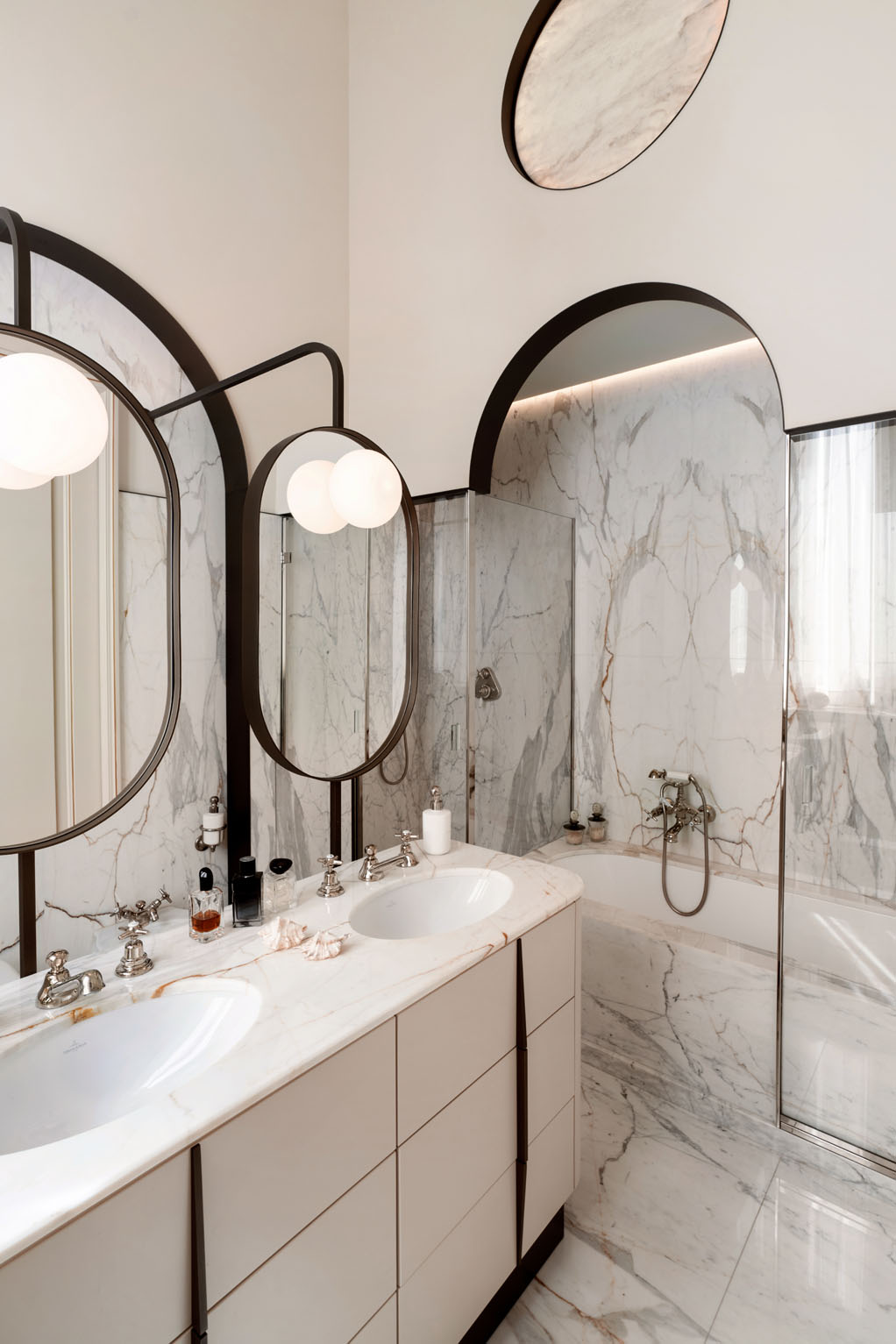
A concrete example of how reflective surfaces can transform a high-end interior is the project completed for a luxury residence in Milan, curated by the 8&A Architetti studio in collaboration with Vetreria Re.
In the bathroom areas, custom-made mirrors featuring arched profiles and integrated backlighting dialogue with marble wall coverings, becoming true dramatic focal points. In the home gym, the installation of full-wall mirrors visually amplifies the space and reflects natural light, demonstrating how custom glass craftsmanship can seamlessly combine aesthetics, visual continuity, and functionality in prestigious residential environments.
Expertise and Engineering: The Vetreria Re Signature
Realizing mirror walls and reflective boiserie for residential or contract projects requires an approach extending far beyond simply supplying the sheet. The success of an interior styling intervention based on mirrors depends on the precision of execution surveys, cut engineering, and installation quality.
Every project signed by Vetreria Re stems from an open dialogue with architects and interior designers. The ability to handle complex processes—from edge beveling to preparing housings for outlets and lighting points, up to integrated LED backlighting—transforms design mirrors into architectural elements fully integrated into wall structures.
Choosing custom solutions guarantees perfect panel planarity, long-term silvering durability, and enhancement of every single finish detail, ensuring a final result aligned with high-end architectural standards.
If you are designing a residential or contract space and wish to explore the expressive potential of reflective walls and custom mirrors, the Vetreria Re technical team is at your disposal to support you in defining finishes, processes, and dedicated installation solutions.