

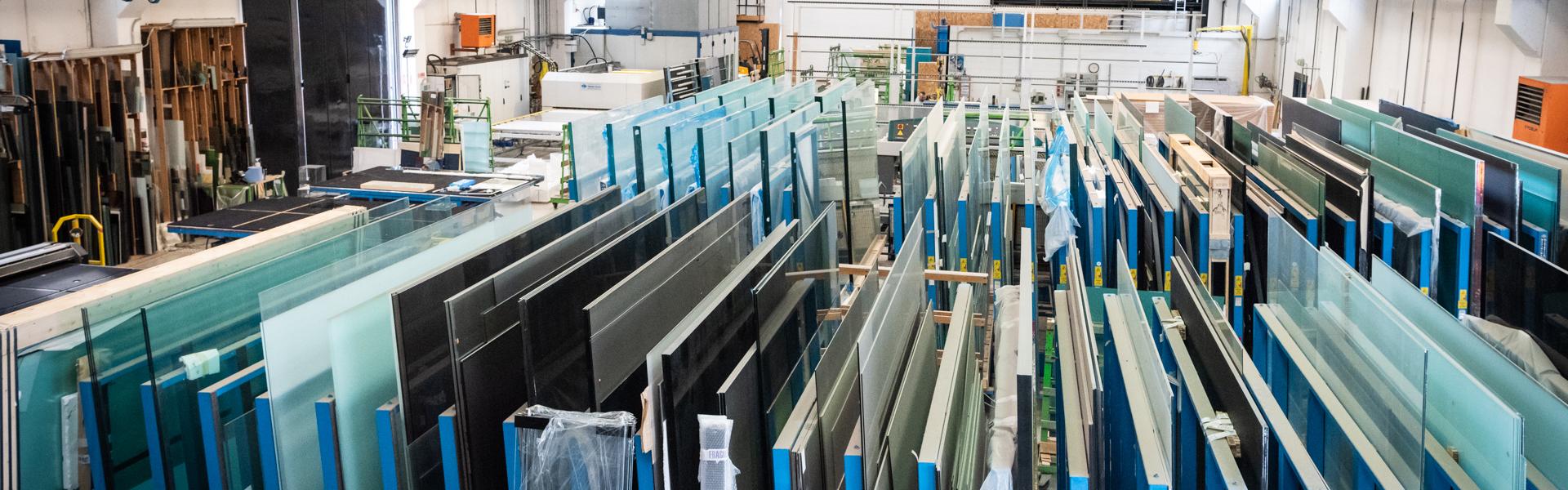
The term industrial glass generally refers to all glass types that are not “artistic glass.” This includes glass and processes whose primary purpose is not decorative, but rather functional or technical. Within this category, flat glass (or sheet glass) represents the largest share of industrial production and includes safety glass varieties such as laminated, tempered, armored, and anti-intrusion glass.
Industrial Flat Glass and the Float Method
The industrial flat glass sector includes several types, though approximately 90% of the world’s production is now made using the float method, patented by Alastair Pilkington. In this process, molten glass is poured onto a bath of molten tin in a controlled atmosphere. Because glass has a lower specific gravity than tin, it spreads across the surface, creating a naturally smooth and flat layer. As it cools, it solidifies into a continuous ribbon with perfectly parallel surfaces.
However, standard float glass is not classified as safety glass. When it breaks, it shatters into large, sharp shards that are extremely dangerous. According to building regulations, float glass cannot be used in risk-prone areas or applications subject to impact. For bathrooms, glass doors, railings, storefronts, schools, and hospitals, it is mandatory to use safety glass—either tempered or laminated.
Tempered and laminated glasses are the most common industrial flat safety crystals. They are designed so that, in the event of breakage, they do not pose a risk to people. Furthermore, these safety crystals offer superior mechanical strength and resistance to break-in attempts, making them the ideal choice for shop windows, urban furniture, staircases, and flooring.
To ensure a high-quality finish, industrial flat glass can undergo several specialized processes:
-
Cutting: Performed manually for small pieces or via automated cutting tables.
-
Grinding (Molatura): Eliminates irregularities on the edges for a smooth, uniform result.
-
Drilling: Executed with diamond-tipped drills or advanced waterjet machinery for maximum precision and silence in the structural assembly.
Vetreria Re: Design and Manufacturing of Industrial Flat Crystals
Vetreria Re manages the design, manufacturing, and processing of industrial flat crystals at 360°, supporting clients through every phase of their project. With over 20 years of experience in Italy and abroad, Vetreria Re is the ideal partner for creating architectural glass elements for residential, commercial, and industrial environments that prioritize both aesthetics and comfort.